Reliability centred maintenance, backed by your failure data
Build Function → Failure → Mode worksheets where each decision links to the analysis that justifies it — and stays linked, so the study flags the decision when the data stops agreeing.
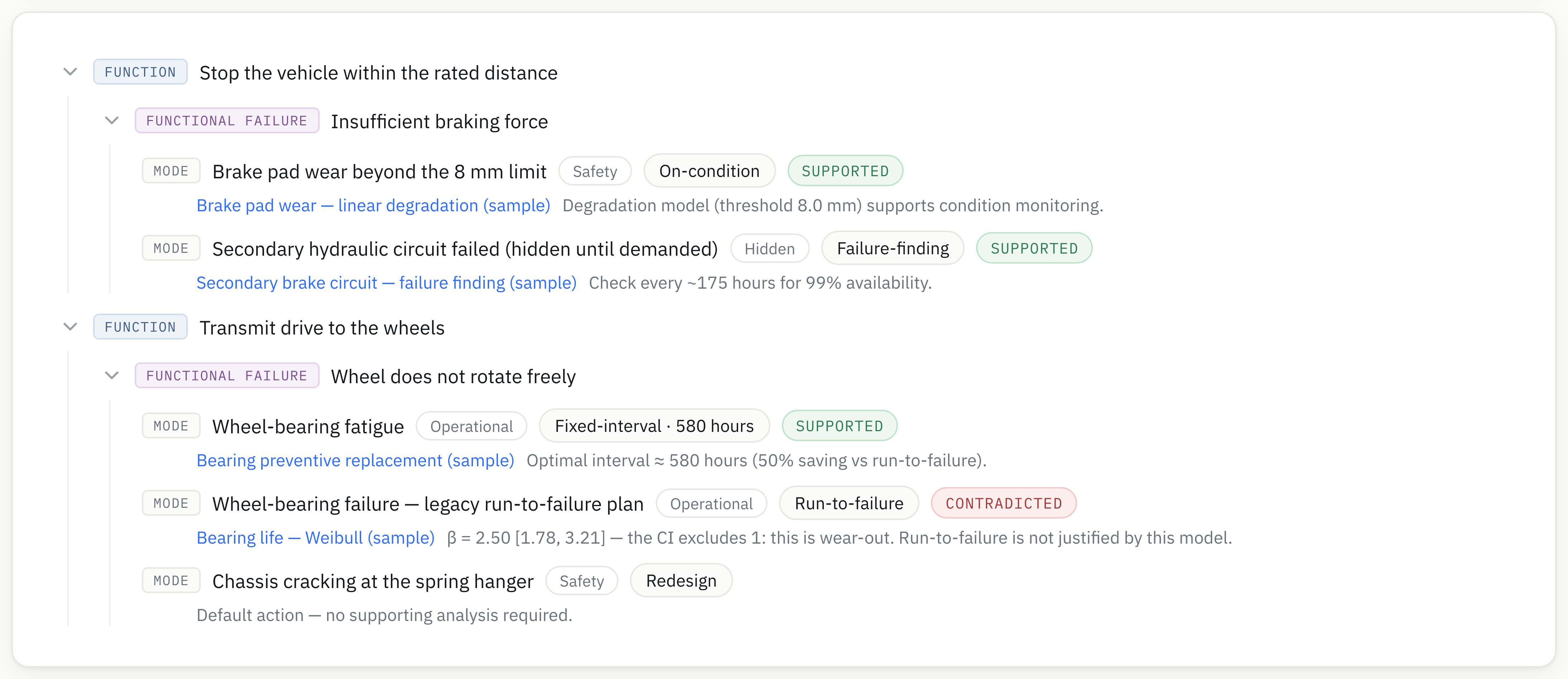
Decisions that cite their evidence
Most RCM tools are structured note-taking: the worksheet records that the team chose a fixed 6-month interval, but not why, and nothing ever checks the why again. In Reliafy, each decision links to the analysis behind it — a run-to-failure call cites the fitted non-repairable model showing failures are random; a fixed interval cites the cost-optimal replacement analysis; an on-condition task cites the degradation model; a failure-finding interval cites the availability calculation.
Contradicted, not quietly stale
The links stay live. When new failure data shows a "random" failure mode is actually wearing out, the study flags that decision as contradicted — with the evidence one click away — instead of letting the worksheet drift out of date for five years. Each study counts how many of its decisions are supported, inconclusive or contradicted, so a review starts from a summary rather than a binder.
The classic structure, without the ceremony
Worksheets follow the standard decomposition — functions, functional failures, failure modes with effects and consequences, then the maintenance decision, its task and its interval. The same study opens as a table or as a nested list, and the whole worksheet exports to CSV for reports and audits.
Built on real analyses, in the same tool
The evidence isn't imported from somewhere else — you fit the non-repairable models, replacement intervals, and degradation models in the same platform, from the same datasets. Teams work in a shared workspace. Walk through a complete worked RCM example — a pump system, five failure modes, every decision reasoned — or start from the built-in sample study: a delivery truck, with one decision contradicted on purpose.
Your next RCM review could check itself.
Start from the sample study and link your first decision to real evidence — free.
Get started free