Set a failure-finding (proof-test) interval
Before you start: A life model of the protective device, as a saved fit or a failure rate you can type in, and the availability you need from it.
Some failures announce themselves: a pump stops and the line goes quiet. Others don't. A relief valve that has seized, a trip that won't trip, a standby generator that won't start: each looks fine until the day it's needed. These are hidden failures, and the only way to find one before it matters is to test for it.
A failure-finding interval answers how often to test. Test too rarely and the device spends too long broken without anyone knowing. Test too often and you pay for tests that find nothing. Reliafy works the interval out from the device's life model and the availability you need from it.
Enter the device's life
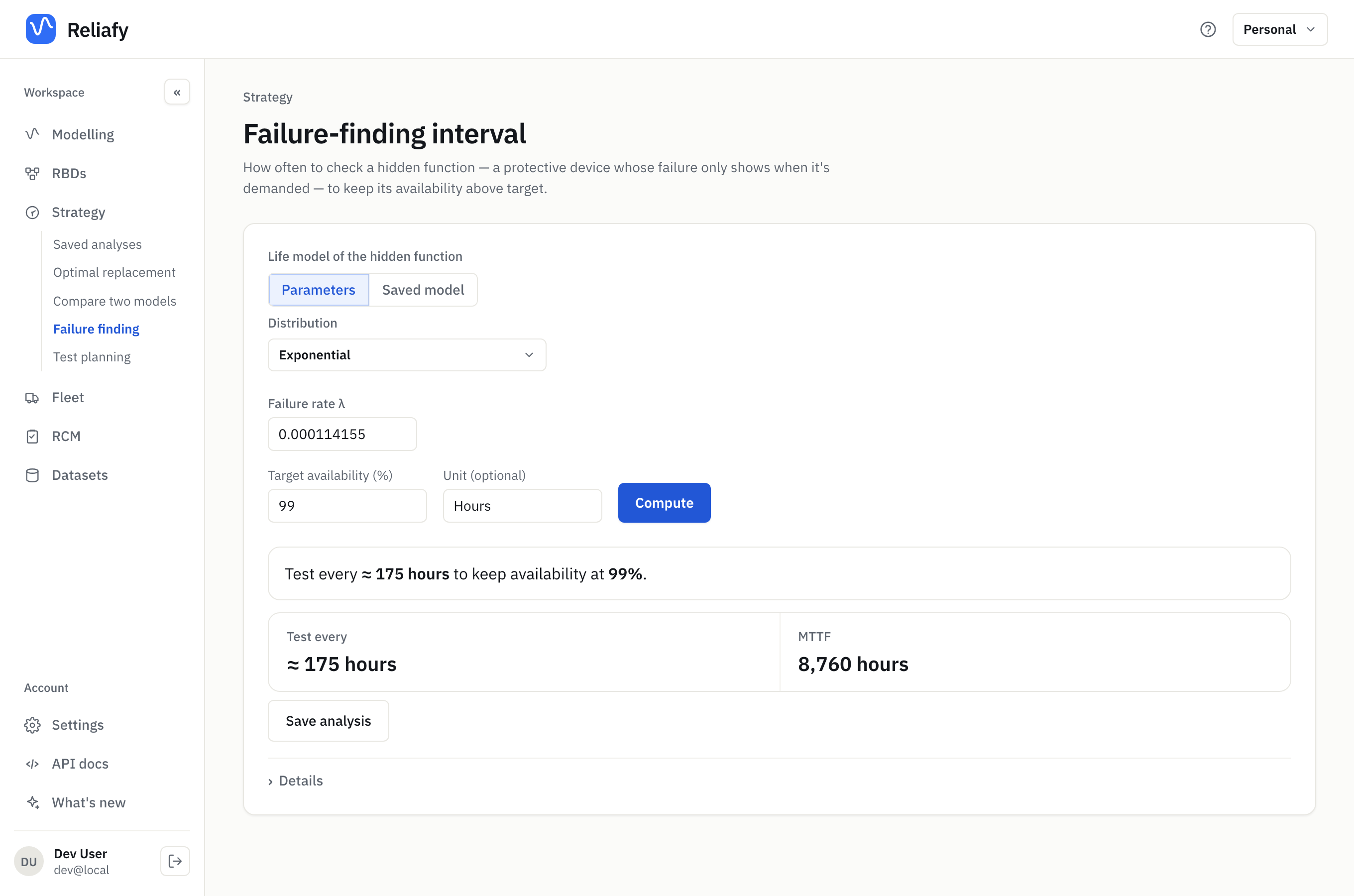
Open Strategy → Failure finding. Under Life model of the hidden function, choose where the life model comes from:
- Saved model — a fit from your own failure data.
- Parameters — a distribution and its parameters typed in, for a handbook or vendor figure.
For a protective device the vendor figure is usually a constant failure rate. Choose Parameters, set the Distribution to Exponential, and enter the Failure rate λ. For a trip that fails, on average, once a year (8,760 hours), that's 1 ÷ 8,760 = 0.000114 per hour.
Then set the Target availability (%): the fraction of time the device must be able to work when demanded. 99% is a common starting point; your safety study may set a stricter one. Add the Unit (hours here) so the answer reads in it, and press Compute.
Read the answer
The answer is one sentence: Test every ≈ 175 hours to keep availability at 99%. Beside it is the device's mean life, the MTTF, here 8,760 hours.
In plain words: if the device fails at a random moment between tests, it sits failed and unnoticed for, on average, half the test interval. To keep that hidden downtime to 1% of the time, the interval must be a small fraction of the mean life.
Details shows the formula, the standard first-order approximation:
Interval = 2 × (1 − availability) × MTTF = 2 × 0.01 × 8,760 ≈ 175 hours
It's accurate for targets above about 90%. Below that the answer is conservative: the true interval can be longer, and the result says so.
Two things follow from the formula:
- Halving the unavailability halves the interval. Going from 99% to 99.5% means testing twice as often.
- A more reliable device can be tested less often. Double the MTTF and the interval doubles.
The approximation assumes the test is perfect and takes no time, and that a failure it finds is repaired at once. If the test itself takes the device out of service, or doesn't find every failure, or the device sits in a redundant arrangement, model it as a block in a reliability block diagram instead. There a proof-tested block's interval, test coverage and test duration all count.
Save it as evidence
Press Save analysis under the answer, give it a name, and press Save. The result is recomputed on the server from your inputs and stored, and it appears on the Strategy page.
A saved failure-finding analysis is the evidence an RCM study expects for a Failure-finding task. In the study's decision dialog, choose the failure mode's consequence (Hidden), the decision Failure-finding task, the task and its interval, and link this analysis. The decision then reads Supported: Check every ~175 hours for 99% availability. See running an RCM study.
Keep the units the same in both places. If the task interval is in days and the analysis is in hours, the decision is marked inconclusive rather than converted.
Where to go next
If the item's failures are evident rather than hidden, the question is when to replace it, not when to test it: see find the optimal replacement interval.
For a repairable system that is repaired as it fails and overhauled from time to time, the Overhaul tab of a recurrent model finds the overhaul interval that costs least. See repairable systems.
For a safety instrumented function, where several devices vote and each has its own proof test, see verify a safety function.